5 Signs Your Team Has a Collaboration Problem (And How to Fix It)
5 Signs Your Team Has a Collaboration Problem (And How to Fix It)
Here's an uncomfortable truth: most teams overestimate how well they collaborate. In a recent study by the Institute for Corporate Productivity, 96% of executives cited lack of collaboration as the primary reason for workplace failures — yet most of those same leaders rated their own team's collaboration as "good" or "excellent."
The disconnect exists because poor collaboration is often invisible. It doesn't look like conflict or dysfunction. It looks like meetings that run long, projects that drift off schedule, and good ideas that somehow never get implemented.
If any of the following five signs sound familiar, your team might have a collaboration problem hiding in plain sight.
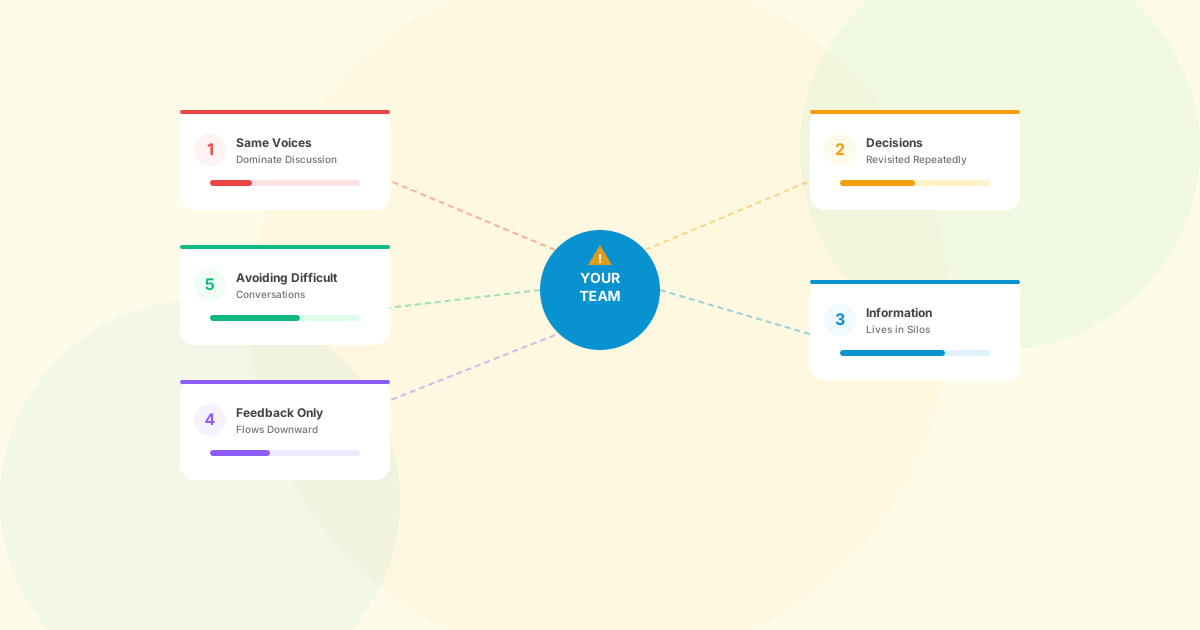
1. The Same Two or Three People Do Most of the Talking
This is the most common — and most overlooked — collaboration problem. In meetings, brainstorms, and group discussions, a small number of voices dominate while others stay silent.
It's tempting to blame quiet team members for not speaking up. But research consistently shows that participation patterns are a function of environment, not personality. MIT's Human Dynamics Laboratory found that in the highest-performing teams, members contributed roughly equally to discussions — regardless of their personality type or seniority.
When a few voices dominate, you lose:
- Diverse perspectives that could improve decisions
- Early warning signals that quieter members might spot
- Buy-in and ownership from people who didn't contribute to the decision
How to fix it
Structure participation deliberately. Use round-robin formats where every person speaks before anyone speaks twice. Try silent brainstorming where ideas are written before discussed. In simulations, assign specific roles so every team member has a domain of responsibility that requires their input.
The goal isn't to force introverts to behave like extroverts. It's to create systems where every perspective reaches the table.
2. Decisions Get Revisited Repeatedly
If your team frequently reopens decisions that were supposedly finalised, it usually means one of two things: either the decision-making process wasn't thorough enough, or not everyone genuinely agreed.
This pattern — sometimes called decision recycling — is incredibly costly. Teams end up relitigating the same issues week after week, consuming time and energy that should go toward execution.
The root cause is often a lack of productive disagreement during the decision process itself. When people don't feel safe expressing concerns upfront, those concerns resurface later as resistance, "new information," or requests to revisit.
How to fix it
Build explicit disagreement into your process. Before finalising any significant decision, ask: "Who has concerns they haven't raised?" and "What could go wrong that we haven't considered?"
Use pre-mortem analysis: imagine the decision has already failed, and ask the team to brainstorm why. This gives people a safe framework to voice doubts without feeling like they're being obstructionist.
Once a decision is made, document the reasoning — not just the conclusion. When someone wants to revisit, you can point to the process and ask: "What's changed since we made this decision?"
3. Information Lives in Silos
Does your team have a "single point of failure" problem — key knowledge that only one person holds? Do team members frequently discover that relevant information existed but wasn't shared?
Information hoarding is rarely intentional. It usually happens because there's no system for sharing, or because people don't realise what they know is relevant to others. But the effect is the same: the team consistently makes decisions with an incomplete picture.
In our simulation data, teams where information flows freely between members make decisions that are up to 30% more effective than teams with siloed knowledge — even when the siloed teams have more experienced individual members.
How to fix it
Create structured sharing moments. Start meetings with a quick round of "what I've learned this week that might be relevant to others." Use shared documentation that's actively maintained, not just created.
More importantly, practise information sharing in low-stakes environments. Simulation exercises are powerful here because they create scenarios where team members hold different pieces of a puzzle. Teams quickly learn that withholding or forgetting to share information leads directly to worse outcomes.
4. Feedback Only Flows Downward
In teams with a collaboration problem, feedback tends to be hierarchical: managers give feedback to reports, but not the other way around. Peer-to-peer feedback is rare or superficial.
This matters because the people closest to the work often have the best insights about what's going wrong. When feedback only flows downward, leaders operate with a filtered version of reality, and team members miss opportunities to help each other improve.
A 2023 study in the Harvard Business Review found that teams with robust peer feedback mechanisms were 26% more effective at identifying and resolving problems before they escalated.
How to fix it
Normalise peer feedback through practice. The reason most people avoid giving peer feedback isn't that they don't have observations — it's that they lack practice doing it constructively.
Structured debriefs after team activities are one of the most effective ways to build this muscle. Focus feedback on process and behaviours, not personalities: "When we made the decision about X, I noticed we didn't hear from everyone. Next time, we could try..."
Simulation-based team exercises provide natural debrief opportunities because the experience is shared, the stakes are low, and the focus is on collective improvement rather than individual evaluation.
5. Your Team Avoids Difficult Conversations
Perhaps the most telling sign: when important but uncomfortable topics consistently go unaddressed. The product launch that everyone knows is behind schedule. The team dynamic that everyone tiptoes around. The process that clearly isn't working but nobody raises.
Patrick Lencioni's model of team dysfunction places fear of conflict as the second most fundamental problem (after absence of trust). Teams that avoid difficult conversations don't just miss opportunities to improve — they actively erode trust, because everyone knows the issues exist even if nobody names them.
How to fix it
Build the muscle in safe environments first. This is why crisis simulations are so effective for team development. They create situations where teams must have difficult conversations — about resource allocation, risk tolerance, competing priorities — but in a context where the consequences are learning opportunities rather than career impacts.
Teams that regularly practise navigating disagreement and difficult decisions in simulations report significantly higher comfort levels when those conversations arise in real work.
The Common Thread
Notice what connects all five signs: they're all invisible in normal conditions and only become apparent under pressure. Your team can coast through routine work with mediocre collaboration. It's when challenges arise — tight deadlines, conflicting priorities, unexpected setbacks — that collaboration problems become costly.
That's exactly why practising collaboration under simulated pressure is so valuable. It surfaces the hidden patterns that day-to-day work conceals, and gives teams a safe space to develop better ones.
Take Action
If you recognised your team in any of these signs, the worst thing you can do is nothing. Collaboration problems don't resolve themselves — they compound over time.
The best thing you can do is give your team structured opportunities to practise working together on meaningful challenges, with real feedback on how they performed.
That's precisely what Excelled Team was built for. Start your first simulation and see how your team really collaborates.