How High-Performing Teams Make Decisions Under Pressure
How High-Performing Teams Make Decisions Under Pressure
In 2009, Captain Chesley "Sully" Sullenberger had 208 seconds to decide how to save 155 lives after both engines of US Airways Flight 1549 failed. He landed on the Hudson River. Everyone survived.
When asked about the decision later, Sully didn't credit instinct or luck. He credited preparation. Decades of training, simulation practice, and systematic decision-making frameworks allowed his crew to perform flawlessly when it mattered most.
Most teams will never face life-or-death stakes. But the principle holds: how your team makes decisions under pressure is a direct function of how they've practised.
The Neuroscience of Pressure
When teams face high-pressure situations, something interesting happens in the brain. The prefrontal cortex — responsible for complex reasoning and planning — starts competing with the amygdala, which drives fight-or-flight responses.
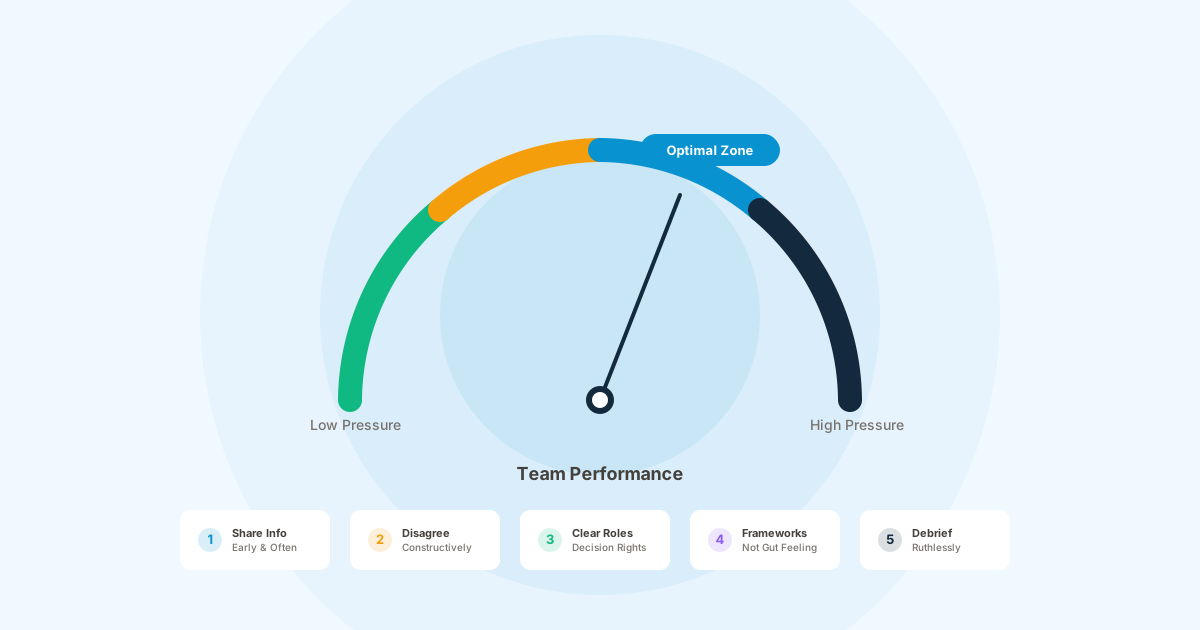
Under moderate pressure, this tension actually improves performance. The Yerkes-Dodson law, established over a century ago and confirmed by modern neuroscience, shows that there's an optimal level of stress for peak cognitive performance. Too little pressure leads to complacency. Too much leads to paralysis.
The problem? Most teams only experience pressure in real situations — when the cost of poor decisions is highest. They never get to practise navigating that optimal stress zone.
Five Patterns of High-Performing Teams
After studying thousands of team simulations, we've identified five consistent patterns that separate high-performing teams from the rest:
1. They share information early, even when incomplete
Average teams wait until they're confident before speaking up. High-performing teams share partial information immediately, prefacing it with uncertainty markers: "I'm not sure about this yet, but..."
This behaviour, known as information elaboration, ensures the team operates with the fullest possible picture. Research from the University of Amsterdam shows that teams practising early information sharing make decisions that are 25% more accurate than those who wait for certainty.
2. They disagree constructively — and quickly
The best teams have a remarkable ability to separate ideas from identities. They challenge each other's reasoning without it feeling personal. More importantly, they do it fast.
Studies on surgical teams by Amy Edmondson at Harvard found that the highest-performing teams actually reported more mistakes and disagreements — not because they made more errors, but because they had the psychological safety to surface and resolve them quickly.
3. They assign clear decision rights
When time is limited, ambiguity about who makes the final call is deadly. High-performing teams establish decision rights early: Who has authority over which domain? When do we escalate? What decisions require consensus versus individual judgement?
In our simulations, teams that explicitly discuss decision authority in the first five minutes outperform those who don't by a significant margin.
4. They use structured frameworks, not gut feeling
Under pressure, cognitive biases amplify. Confirmation bias, anchoring, groupthink — all become more pronounced when stakes are high and time is short.
High-performing teams counter this with lightweight decision frameworks. Not bureaucratic processes, but simple structured approaches:
- What do we know? What don't we know? — Separating facts from assumptions
- What's the worst case? — Pre-mortem analysis before committing
- Who disagrees and why? — Actively seeking dissent before finalising
5. They debrief ruthlessly
Perhaps the most important pattern: high-performing teams treat every experience as a learning opportunity. Military after-action reviews, aviation crew debriefs, surgical mortality conferences — the highest-stakes professions have long understood that structured reflection is where real improvement happens.
The best debriefs focus on process, not outcomes. A good decision that happened to produce a bad result is still a good decision. A bad process that got lucky is still a problem.
Why Practice Matters More Than Theory
You might read these five patterns and think, "That makes sense — I'll share this with my team." But here's the catch: knowing these principles and executing them under pressure are entirely different things.
Consider an analogy. You can read every book about swimming technique, watch hours of instructional videos, and understand the physics of buoyancy perfectly. But the first time you jump in the deep end, none of that knowledge helps unless you've practised.
Team decision-making works the same way. The neural pathways that enable calm, structured thinking under pressure only develop through repeated practice in realistic scenarios. Classroom learning builds awareness. Simulation builds capability.
Building Your Team's Decision Muscle
The good news is that decision-making under pressure is a trainable skill, not a fixed trait. Teams that regularly practise with realistic simulations show measurable improvements in:
- Decision speed: Less time debating, more time acting
- Decision quality: Fewer cognitive biases, more structured reasoning
- Team coordination: Clearer communication, better information sharing
- Psychological safety: More willingness to speak up and challenge assumptions
At Excelled Team, every simulation is designed to place teams in that optimal pressure zone — challenging enough to trigger real decision-making behaviours, safe enough to learn from mistakes without real-world consequences.
Because when the pressure is real, you want your team to have practised for it.
Want to see how your team performs under pressure? Start a free simulation and find out.